
Cutting rework and improving production efficiency for Safran Nacelles
Background
Safran Nacelles, a global aerospace company and Tier Two Member at the University of Strathclyde’s Advanced Forming Research Centre (AFRC) within the National Manufacturing Institute Scotland (NMIS) designs, manufactures, and supports engine nacelle systems.
Challenge
One of Safran Nacelles thin-gauge aluminium components, formed using a rubber press process, was experiencing up to 25 mm of springback. This is when a metal part shifts shape after removing the forming load, as the material ‘springs’ back towards its original position, leaving parts out of tolerance and requiring manual correction.
The level of variation due to springback was causing significant rework, longer lead times, and increased labour cost. Safran required a more predictable and repeatable forming process that delivered consistent geometry while reducing manual adjustment.
What did NMIS do
The NMIS- AFRC team used advanced computer modelling and forming expertise to analyse Safran’s existing rubber press process and identify the main causes of springback. The team then developed an improved forming configuration that introduced controlled stretching to stabilise the material during pressing.
Trials at Safran Nacelles UK showed clear improvements. Several samples displayed minimal wrinkling and significantly improved accuracy, with a representative trial part reducing variation from around 25 mm to 2 mm, verified through 3D scanning.
Impact
The improved setup delivered a clear improvement in part quality and production efficiency:
- Up to 85% reduction in springback
- Less rework and manual adjustment
- More consistent, repeatable parts
- Reduced labour hours and cost
The validated approach provides Safran Nacelles with a more robust and efficient forming process, with potential to apply the method to similar components across production.
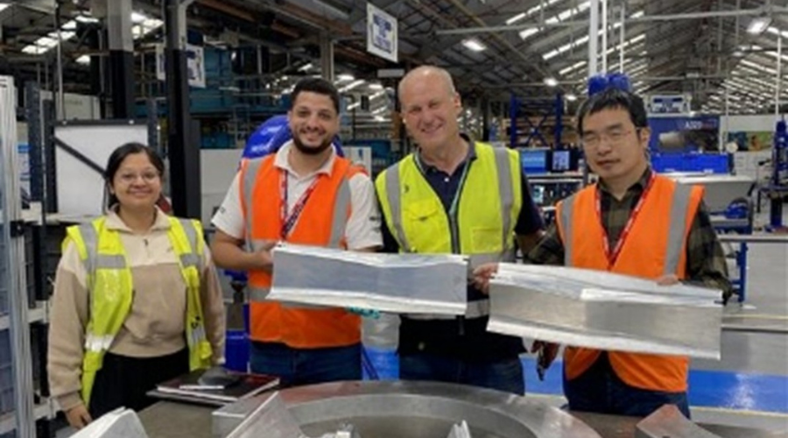
Nick Scowcroft, Engineering Team Leader, Safran Nacelles
Using the NMIS- AFRC’s expertise in forming and process simulation, we have been able to accurately predict aluminium behaviour during rubber pressing and drastically reduce the non-value-added setting operation on a family of high-volume parts.
The team supported production trials at Safran Nacelles, and it was fantastic to achieve the results predicted by the simulation, with parts achieving accurate geometry straight off the press and requiring far less manual adjustment. We are very pleased with the outcome and look forward to defining our next project together